31 entries

  1. 01

    Chick-a-dee phrase

    The call that gave the bird its name, used whenever the message is "come here" - when separated from a mate or flock, when mobbing a predator (often with many dee notes), as an all-clear after a predator leaves (especially by high-ranking birds), and when a new food source turns up. More dee notes are added for more menacing predators, and birds respond more intensely to playback of such calls. Spectrograms - Macaulay Library ML512817931, ML503817651, ML504929941.

    Frequency
    On average, A notes start at 5700 Hz, B notes start at 3300 Hz, and C notes start at 1700 Hz.
    Function
    Alarm, contact between mates, identifying social group, mobilizing winter flocks; a general recruitment call for food and threats.
    --:--
  2. 02

    A-B-D chick-a-dee phrase (hawk nearby)

    A-B-D and A-D versions given by one bird while another stayed frozen several feet away, in response to a nearby sharp-shinned hawk. Listen for the single high "zee" or "tseet" at the 10-second mark, often used when a predator is around. Macaulay Library ML503822931.

  3. 03

    A-B-D chick-a-dee phrase (familiar dog)

    A-B-D versions given in response to a dog the birds were familiar with. Macaulay Library ML503850411.

  4. 04

    A-D chick-a-dee phrase

    A-D versions recorded while a human hand-fed a wild nuthatch with a chickadee nearby. In the companion video, a male gives one A-D call in response to a person calling for a dog. Macaulay Library ML503852531.

  5. 05

    B-D chick-a-dee phrase

    B-D versions of the call. From the chickadee's perspective, are these the same as A-D sequences? Macaulay Library ML503853331.

  6. 06

    B-C-D and C-D chick-a-dee phrase

    Given in response to a known dog that approached. As with D syllables, C syllables have been shown to be repeated for emphasis, at least in Carolina chickadees (for example, when first finding food). Macaulay Library ML503854021.

  7. 07

    C-D chick-a-dee phrase

    C-D with irregular D-note patterns, in response to a shrike attack. Macaulay Library ML503856401.

  8. 08

    Rapid D mobbing phrase

    D syllables in the fast, repetitive pattern used to mob a predator, with occasional A syllables mixed in. In one recording a nuthatch ("erp, erp") alarms along with the chickadees; in another, the birds respond to a northern pygmy-owl. Macaulay Library ML503858471, ML507264051.

    Function
    Mobbing a predator.
  9. 09

    A-B-A phrase

    A sequence of A and B syllables (with a possible tseet) given as a sharp-shinned hawk flew by. To a chickadee these may be one "morpheme" with variation rather than different "phonemes." Macaulay Library ML503860431.

    Function
    Often used in aggressive or defensive contexts, with a sense of flight rather than fight.
  10. 10

    High zee ("A" phrase)

    A high-intensity alarm call used mainly when a fast-approaching predator is spotted; chickadees hearing it sometimes freeze until they hear a chick-a-dee or contact call. It is similar to the tseet contact call, but the A note tails off in frequency at the end where the tseet ends suddenly. This series came from a bird in a bush watching a perched goshawk (Macaulay Library ML503862071).

    Function
    Alarm for a fast-approaching predator.
    --:--
  11. 11

    A phrase from a juvenile

    A juvenile's call after a sudden fly-by of a starling. It looks similar in form to an A syllable and seems to function like a high zee, indicating a threat. Macaulay Library ML503866491.

  12. 12

    Seet series ("A" phrase)

    A series of A syllables, sometimes called a seet series. Like the mobbing dee phrase, repeating A (and C) syllables could signal the emphasis or intensity of the situation. Macaulay Library ML503867851.

    Function
    Often used in aggressive or defensive contexts, with a sense of flight rather than fight.
  13. 13

    Contact calls with gargle

    A series of contact calls (similar to an A syllable) and a gargle from a chickadee in response to a nuthatch during feeding. This would be a rare interaction; the bird may have been answering another chickadee that was not seen. Macaulay Library ML503864141.

  14. 14

    C phrase

    The C syllable is often used alone in rapid succession when a bird is alarmed or flying away. One way to think of A, C and D phrases is as synonyms used for reasons not yet known, the way a person might say "I'm mad at you" to family but "I despise you" to someone outside their social group. Macaulay Library ML504057121.

    Function
    Alarm, often in aggressive or defensive contexts.
  15. 15

    Contact call

    A soft call (sometimes called a tseet or psip) given almost continuously by undisturbed chickadees of both sexes throughout the year. Because these calls are soft, we may not have a full catalog of close-contact sounds. Macaulay Library ML503868931, ML513119421.

    Function
    Likely to let nearby birds know where the caller is.
    --:--
  16. 16

    Fee-bee phrase

    The chickadee's short, simple song, often called "fee-bee" or "hey sweetie." Around Yellowstone it typically has two syllables, the second a consistent downshift in frequency; a bird may switch between higher and lower versions. Females sing it too, especially near nest sites, though female song is less studied. Macaulay Library ML503874301.

    Frequency
    The second syllable is a consistent down-shift in frequency.
    Function
    Territorial advertisement and attracting mates; males also use it to announce themselves at the nest with food.
  17. 17

    Fee-bee duel

    A fee-bee duel between two male chickadees in spring. The fainter song comes from a bird about 20 yards from the other.

    --:--
  18. 18

    Fee-bee challenge

    A fee-bee given in spring by a chickadee feeding on a seed. The final fee-bee comes from another bird, and the first bird leaves to inspect. Macaulay Library ML504011461.

  19. 19

    Fee-bee by female at nest

    A banded female sings outside the nest while the male is inside with the brood; chicks beg in the background, then the male leaves and she flies in to feed them. Research suggests the frequency drop within the fee note may identify the singer's sex. Macaulay Library ML504015671.

    Frequency
    In this pair, the female's fee-bee was almost always slightly above 4 kHz at its peak; the male used two variations, one starting at 3.6 kHz and the other at 3.4 kHz.
  20. 20

    Fee-bee by male at nest

    A male sings outside the nest while the female is inside with the brood, perhaps to signal "friend" rather than "foe," since chickadees can identify individuals by their fee-bees. As he approaches, the female gives a broken dee and accepts food. Macaulay Library ML504018371.

  21. 21

    Gargle

    Gargles usually signal heightened aggression and often accompany physical confrontations in winter flocks, typically by males establishing dominance. Each gargle can have several syllables, and social groups share their own set of gargle types. In a sexual context, males sometimes gargle during the dawn chorus, linked to courtship and copulation rather than aggression. This recording has two gargle types from two birds during a squabble (Macaulay Library ML504047631).

    Function
    Dominance and aggression within social groups; courtship in a sexual context.
    --:--
  22. 22

    Gargle with A and C phrases

    Gargles are often combined with rapid-fire A (and sometimes C) syllables. Macaulay Library ML504045891.

  23. 23

    Broken dee

    Given only by females during the breeding season, typically starting when the nest cavity is complete and most often through early incubation; they may still be heard occasionally after the young leave the nest. They sound vaguely like the begging calls of nestlings. Macaulay Library ML513662221.

  24. 24

    Cluck

    Also called a "squawk," it sounds like a chicken's cluck. Both sexes give it at or near the nest when they bring food, in the sense of "I'm here and have food to give you." Macaulay Library ML504051081.

  25. 25

    High-low

    "The call was primarily associated with aggressive encounters among conspecifics," as first described by Haftorn, Huang, Griswold and Hailman (2008). We do not have a recording yet; send us yours.

  26. 26

    Pitter

    A series of rapid, broadband, rough syllables, usually from the female (sometimes the male) during an exchange at or near the nest, such as when the male flies in with food. The female often leaves the nest afterward, so the call may ask the male to attend the nest; it is always accompanied by wing flaps. Macaulay Library ML504052641.

  27. 27

    Begging dee

    Given only by young birds, typically those fledging, while begging for food. It is unclear whether it is an undeveloped chick-a-dee call, though observations of the same juveniles over time suggest it might be (Macaulay Library ML504053781).

    Function
    Requesting food, and perhaps signaling the youngster's whereabouts.
    --:--
  28. 28

    Hee haw haw

    Perhaps first described here, unless it is a variation of the broken dee. Often given by the female when she arrives (often with food) while the male is in the nest, and she wants him to leave. Macaulay Library ML506356451.

  29. 29

    Hiss

    Made by an adult chickadee protecting chicks inside a nest cavity, also called the "snake display." Macaulay Library ML504058451.

  30. 30

    Pit

    Similar to a broken dee but fainter and broader in frequency, given by a female at a nest site. Have an idea what it might be for? Macaulay Library ML505030631.

    Function
    Unknown.
  31. 31

    Snarl

    Described by Ficken et al. (1972) as similar to the hiss, heard during rare fights when a strange male came within 10 m of a nest cavity; they suggested it may be given when the tendency to attack is stronger. We do not have a recording yet; send us yours.

The black-capped chickadee is one of North America’s most common and widely distributed birds, found from coast to coast across much of Canada and the northern two-thirds of the United States. They don’t typically migrate, staying in their range year-round. As you would expect of a social animal, their vocal behavior is complex: adults have at least 16 different kinds of vocalizations.

How to listen

The compilation recording in the Macaulay Library strings together at least thirteen types of sounds, or what humans think of as syllables, from various birds recorded in 2020–2022 just north of Yellowstone National Park. The entries below are loosely ranked from most to least common. Each has a name (following Peterson’s guide wherever possible), a brief description, and where we have one, a recording; the Macaulay Library number (ML) points to a spectrogram playback of that sound.

The aim is first to help you tell the common sounds apart, and second to introduce some of their functions, or meanings, in real communicative events. Remember that what a chickadee hears, and therefore interprets, is not necessarily what we hear.

The chick-a-dee call

The classic chick-a-dee call is built from four syllables, labeled A, B and C (the “chick-a”) and D (the “dee”). They can be used separately or together, with or without every syllable, but always in that order. The call is learned and comes in many variations. A, B and C syllables vary a lot between birds, especially in frequency, duration and loudest frequency; since birds can discriminate as little as a 1% change in frequency, starting and ending frequency should let them tell A, B and C apart. The most common combinations are A-D and B-C-D.

D syllables, the most common, vary in length, spacing, loudness and pitch contour, and can be used on their own, perhaps encoding the caller’s identity. Social groups appear to have their own “signature” chick-a-dee call, and stronger research shows that population of origin shapes syntax and phonetics, something like a dialect. The number of distinct combinations grows with sample size, a trait human languages share, and as A, B or C syllables increase in a call, D syllables tend to decrease. Hunger, hormones, season, sex, feeding behavior, social context and how close a threat is may all shape the call. Other parids use similar and different syllables, but a similar-sounding syllable may function differently in another species.

Syllables, words or sentences

These sounds could be the equivalent of phonemes (sounds without meaning on their own), morphemes (sounds with meaning that never stand alone), words, phrases or whole sentences. We don’t always know. An English speaker can break “IMADEHERDUCK” into its meaningful parts even though it looks like one word, but current research suggests birds do not perceive sound sequences quite the way human brains do.

Playing these sounds back to wild birds and watching how they react lets us grasp the gist. Alarm calls are among the easiest for us to understand, yet changes in pitch, timing and loudness may carry more than “alarm,” such as who is calling. And the D note might be a homonym whose meaning shifts with context, like “meat” and “meet.” There is a lot left to learn, and much we may never understand.

Share your sounds

We are still looking for recordings of the high-low and snarl calls, and for any sound you think we have missed. Leave us a note in the sign-up form at the bottom of this page, and we will tell you how to send your audio or video.

Credits

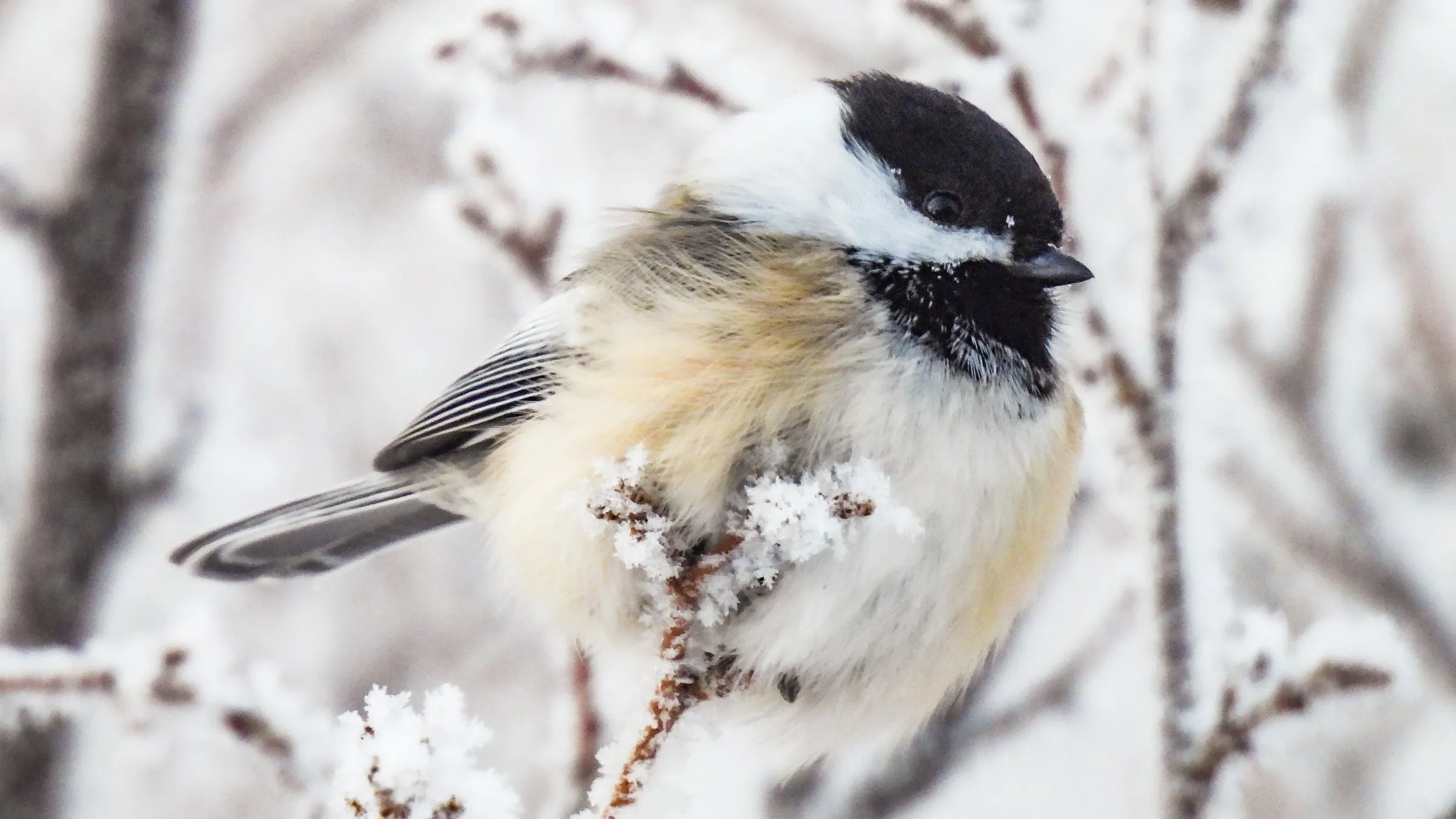
Recordings made just north of Yellowstone National Park, with spectrograms in the Macaulay Library. With thanks to the researchers whose work informs these descriptions, including Todd Freeberg, the Sieving Lab, the Gall Lab and the Songbird Neuroethology Lab, and to Birds of the World, the Peterson Field Guide and eBird. Hero photo by Jeffrey Reed.

Videos from the field

  • Black-capped and mountain chickadee calls compared

  • A-B-D call with a sharp-shinned hawk nearby

  • Male fee-bee and an A-D call near the nest

  • Mobbing a northern pygmy-owl

  • A juvenile's alarm at a starling fly-by

  • C phrase

  • Contact calls at a feeder

  • A rare call by a female before egg laying

  • Fee-bee duel, with mountain chickadee and other parid songs

  • Fee-bee challenge

  • Fee-bee by a female at the nest

  • Fee-bee by a male at the nest

  • Gargle with A and C phrases

  • Cluck during food transfer at the nest

  • Pitter

  • Begging

  • Hee haw haw

  • Hiss

  • Pit

Sources and credits

  1. Macaulay Library, dictionary compilation recording (ML503376871)
  2. Macaulay Library, black-capped chickadee recordings referenced on this page (search by ML number)
  3. Birds of the World, black-capped chickadee
  4. Peterson Field Guide to Bird Sounds, black-capped chickadee
  5. eBird, black-capped chickadee
  6. Connected Papers, black-capped chickadee research
  7. Todd Freeberg, University of Tennessee
  8. The Sieving Lab, University of Florida
  9. The Gall Lab, Vassar College (Project Chickadee)
  10. Songbird Neuroethology Lab
  11. Female song in black-capped chickadees (Poecile atricapillus): acoustic song features that contain individual identity information and sex differences
  12. Haftorn, S., Huang, W.-C., Griswold, C. K., & Hailman, J. P. (2008). Independent discoveries of a new, apparently homologous call in the Willow Tit Parus montanus and Black-capped Chickadee Parus atricapillus.
  13. Ficken et al. (1972), description of the snarl call
  14. Further reading on the chick-a-dee call (PDF on the old site)