Coming in 2027. Howl: What Yellowstone’s Wolves Reveal About Language, Dogs, and Our Wild Selves, by Jeffrey T Reed. Published by Little, Brown (Hachette Book Group) in the USA, August 2027.
What does the howl mean?
Most of us hear the wild itself: unfenced country, cold distance, a voice from beyond the firelight. But in Yellowstone, after over 300,000 hours of recorded wolf voices, a deeper story begins to rise from the dark.
Into that mystery walks 907F, Yellowstone’s legendary one-eyed matriarch: survivor, mother, hunter, and queen of Slough Creek. Her life, from her first days in the Lamar Valley to her final winter on the northern range, becomes the thread that leads us into the hidden acoustic world of wolves. It is also the story of her family, the Junctions, and their blood rivals, the Rescue Creek pack. Their feud over territory, bloodline, and survival is told not only in our words, but in theirs, through the recorded voices of wild wolves themselves.
At its heart, this book is about language and what it means to communicate: not the kind written in ink, but the kind carried in air. With autonomous recording units, field observation, and artificial intelligence, Jeff Reed listens into a world human ears have mostly missed. AI helps find the voices hidden in years of wind, rivers, ravens, engines, and snow. But the machine is not the point. The point is listening, the oldest technology we have, and one we have nearly forgotten how to use.
A book to listen to
This is not only a book to read. It is a book to listen to.
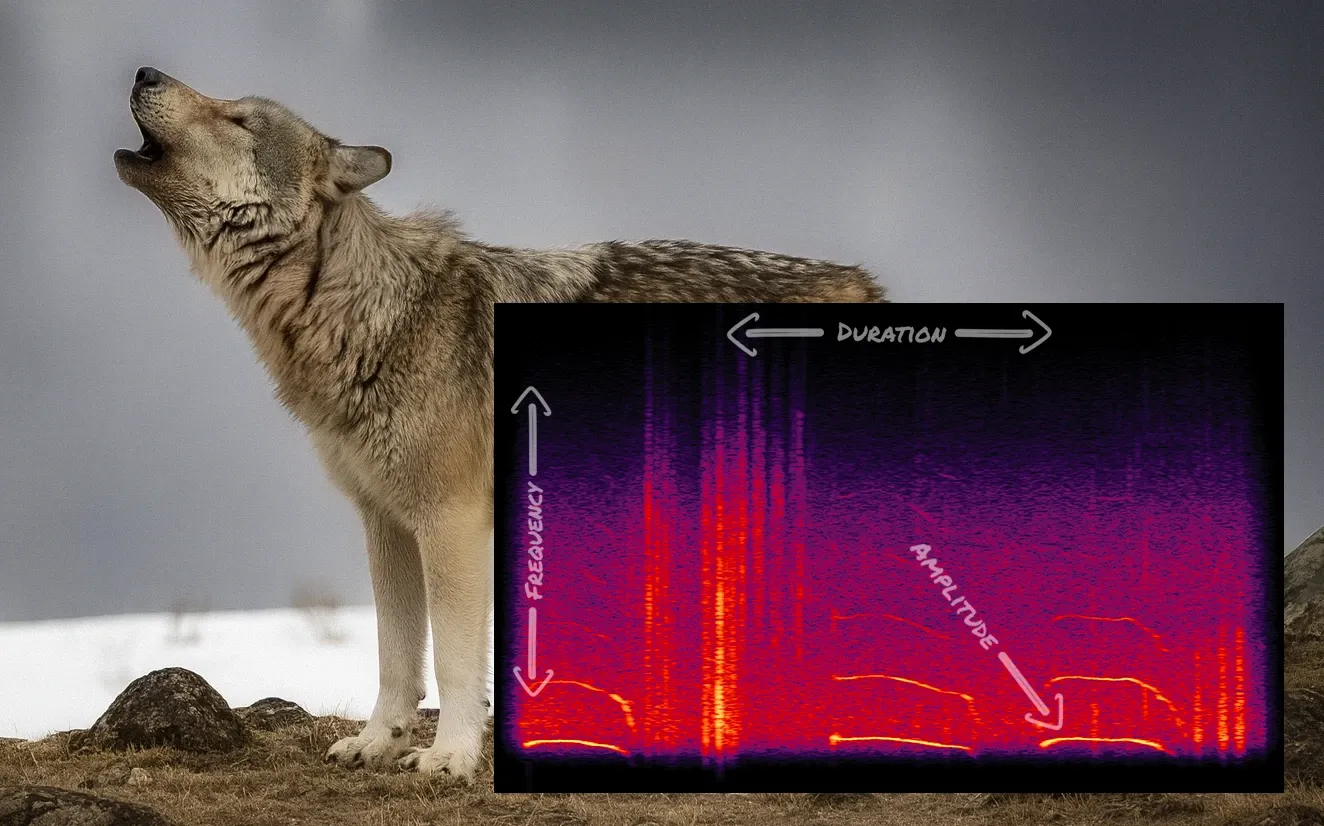
You will hear real wolves: howls, barks, growls, whines, pup voices, and chorus howls. A howl can carry identity across miles. A bark can turn a body toward danger. A growl can stop violence before it begins. A whine can repair a bond. A chorus can make a pack audible as one animal.
Howl is part memoir, part science, and part elegy for the last wild places. It is about wolves. But it is also about the dogs who share our homes, the fragile line between wild and domesticated, and the older self beneath the managed one.
In learning to hear wolves, we are forced to confront a larger loss: the thinning of wild voices around us, and the dulling of our own attention. Wolves returned to Yellowstone and brought back the wild, not as an idea, but as a living presence with teeth, hunger, family, territory, grief, and song. Listening to them may help restore something in us as well: the part that still longs for freedom, sharp attention, honest speech, necessary silence, and a voice used with purpose in a world drowning in noise.
The iconic sound of a wolf pack’s chorus howl reverberating across the Yellowstone landscape is as impactful as seeing the wolves themselves.
— Dr. Dan Stahler
About the author
A feral linguist raised in the mountains of Montana, Jeffrey Reed tracks meaning through howls in the wild, and code in the cloud. He lives where stories still have teeth, near Yellowstone National Park. He questions everything, from ancient alphabets to modern AI, and does it with rigor sharpened by a PhD, three decades in tech, and a lifetime of wilderness grit. Jeff helped found The Cry Wolf Project, one of the largest bioacoustics studies of wolves in the world. After 30 years in the technology industry, he co-founded Grizzly Systems, the Ring doorbell for the outdoors. He also co-founded the Wild Livelihoods Business Coalition, a business movement to protect wild places, not just for today, but for generations to come. He lives with his amazing wife, Robin, and three talkative dogs, Ozzie, Huck and Shiloh, on their farm in southwest Montana.
Sounds and video from the book
The recordings below are the wild wolf voices you will hear in the book, in the order they appear. You can also watch them as a playlist on YouTube.