
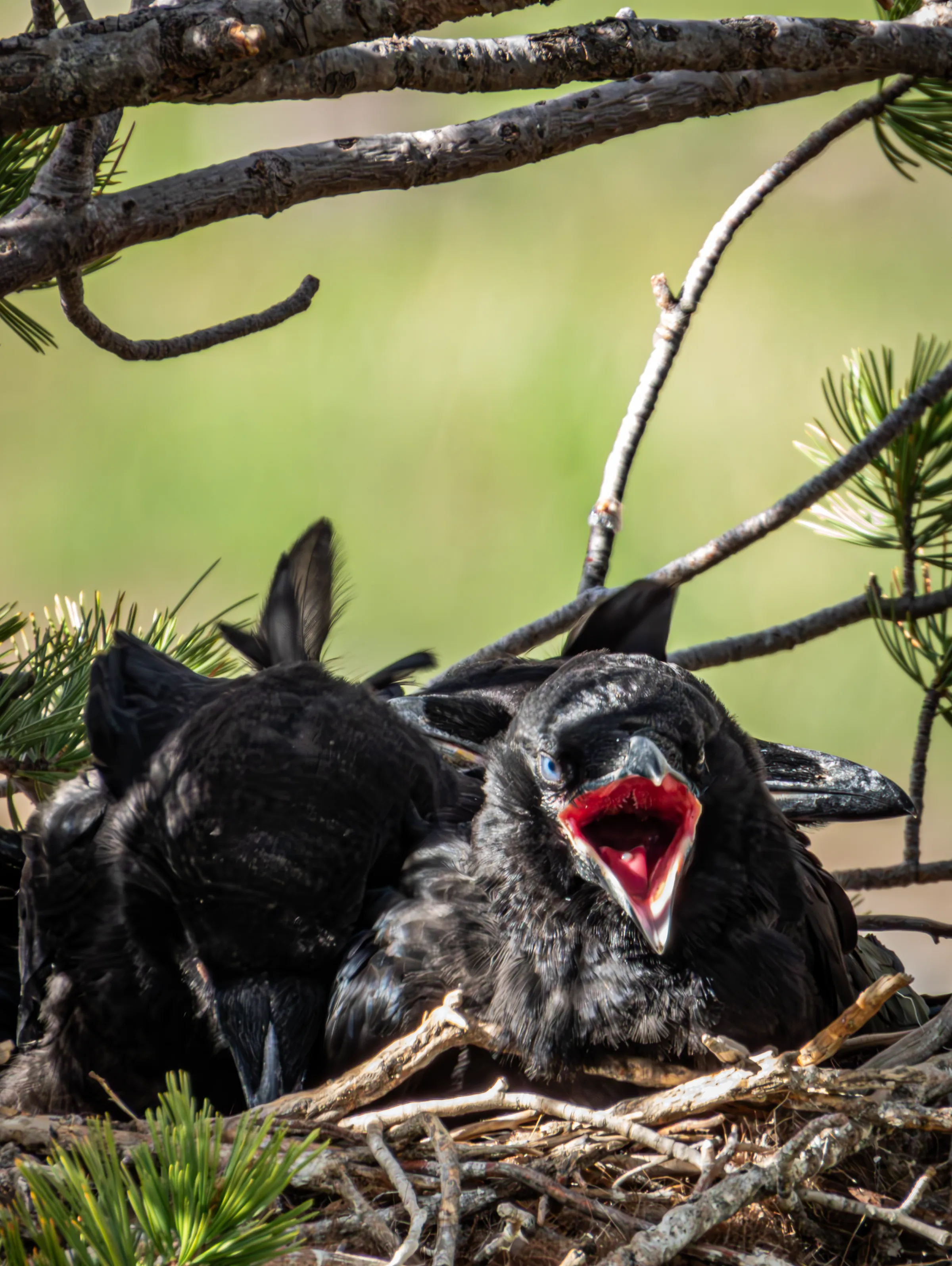
All recordings and descriptions on this page were provided by John and Colleen Marzluff.
Ravens, known for their intelligence and social complexity, communicate through a rich array of vocalizations. They use different calls for different messages: sharp alarm calls that warn others of danger, deep croaks that mark territorial boundaries, calls that announce food and draw in other birds, and contact calls that hold a group together. Juveniles give high-pitched begging calls to ask for food, while adults make low, guttural sounds in courtship displays.
About the recordings
John Marzluff, now retired, has studied corvid behavior extensively. His research highlights not only ravens’ ability to identify individual calls but also their talent for recognizing human faces, a sign of real cognitive sophistication in their social lives and their adaptability.
Calls are best understood from recordings made in a known context, and from watching how ravens respond to call playbacks in experiments. John and his wife, Colleen, did this kind of work while investigating raven winter ecology with Bern Heinrich at the University of Vermont. Their work points to the importance of understanding both the proximate (motivation) and ultimate (evolutionary advantage) drivers of calls if we are to truly understand what a raven is saying, and why.
How to listen
Play each call below and listen for its shape: the short kaw, the doubled quork, the rapid knocks, the crane-like trill. Then watch the Marzluffs’ video of various call types, at the top of this page, to see them in context.