
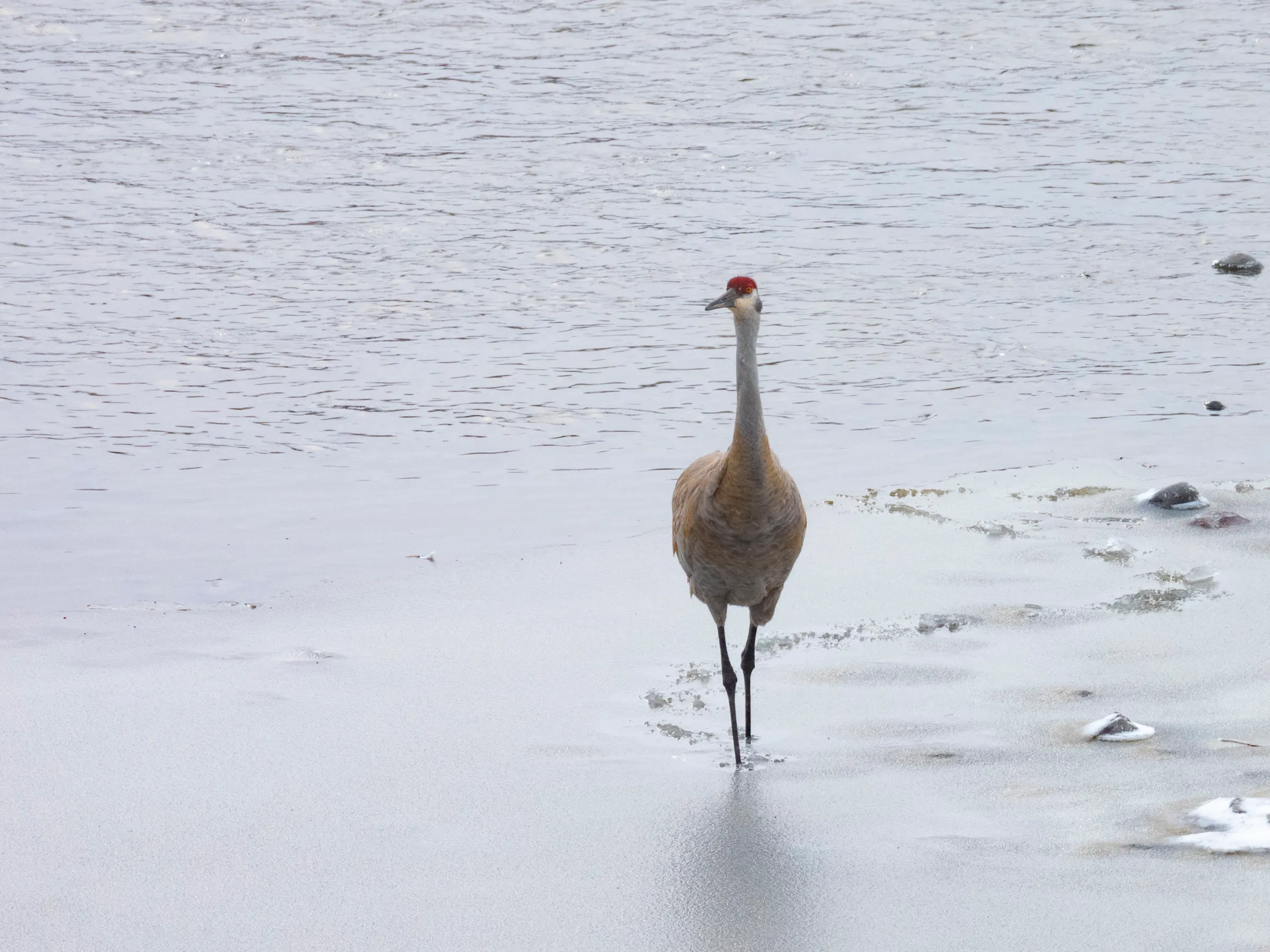
When we hear its call we hear no mere bird. We hear the trumpet in the orchestra of evolution.
Aldo Leopold, A Sand County Almanac
Following the cranes home
The Cry Wolf Project is helping track bird migrations across Yellowstone, and the sandhill crane, one of the loudest birds in North America, is one of our favorites to follow. Our network of acoustic recorders, combined with AI listening for their calls, lets us pinpoint when cranes first appear in different parts of the park.
Think of our recorders as a set of ears spread across a roughly forty-mile-wide stretch of Yellowstone’s Northern Range, each one noting when it first heard the unmistakable call of a returning sandhill crane in the spring of 2025.
The dataset behind this is enormous. It would take roughly five years of continuous listening to hear it all in real time. Instead, I used AI to scan the 50,000 one-hour audio files for the voices of sandhill cranes. The first detection arrived on March 26, 2025, at 11:47 a.m. After that, more sites began to light up in daily waves, just as migration often does when weather and conditions align.
How loud is a crane?
Cranes are loud. At close range their voices can approach about 100 decibels, placing them among the loudest sustained bird calls in North America. The white bellbird of the Amazon currently holds the record at roughly 125 dB, and Yellowstone’s raven can reach around 90 dB, which is why ravens sometimes appear on lists of powerful avian voices.
But decibels are logarithmic. A jump of 10 dB isn’t a modest step; it represents about ten times more acoustic intensity. To human ears that often translates to something like “about twice as loud,” depending on frequency and context. So a crane doesn’t sound like a slightly louder raven. It sounds dramatically louder: more trumpet and rattle than clarinet and caw.
Part of that power comes from anatomy. A sandhill crane’s trachea coils inside its sternum, like a brass horn folded into its chest. The longer vocal tract helps amplify the call by resonating its harmonic bands between 300 and 1,000 hertz. On a calm morning you can hear cranes a kilometer or more away. And when the final note fades, our minds often hold onto the echo even after the air goes quiet.
Ten interesting things about sandhill cranes
- They dance outside of courtship. Crane dancing is not just a mating display. Juveniles dance. Paired adults dance long after forming a bond. Even solitary birds will leap, bow and toss sticks into the air. The behavior likely strengthens pair bonds and coordination, but it also appears to work as practice or play.
- They perform unison duets with remarkable timing. Mated pairs produce coordinated “unison calls” in which the male and female alternate notes in a structured rhythm. These duets help advertise territory ownership and reinforce the pair bond.
- Their calls carry individual signatures. Sandhill crane calls contain distinctive acoustic patterns that let cranes tell individuals apart, helping them recognize mates, neighbors and intruders.
- Parents aggressively defend their chicks. Adults can be formidable when defending their young. They have been documented striking predators such as foxes and coyotes, and occasionally humans, with their long, spear-like bills.
- Chicks can swim very early. Although cranes are mainly walking birds, their chicks, called colts, can enter water soon after hatching. Swimming is an important escape when predators approach.
- Young cranes migrate with their parents. Juveniles stay with their parents through their first migration and winter, learning the route, feeding areas and stopover sites that shape their future migrations.
- They often sleep standing in shallow water. At night cranes commonly roost in wetlands, where shallow water helps deter land predators. They rest standing upright, often balanced on one leg.
- They live surprisingly long lives. Wild individuals commonly reach their twenties, and banding records document some living more than 30 years. They often pair-bond for life, and those bonds can last decades.
- They may delay breeding for several years. Unlike many birds, sandhill cranes often wait several years before nesting. Sexual maturity typically comes between about three and seven years, depending on the population.
- Their conservation story is a rare success. In the early twentieth century, hunting and habitat loss caused major declines. Today sandhill cranes number in the hundreds of thousands across North America, one of the continent’s notable conservation recoveries.