
If your body were every land mammal on Earth
Most of you would be us. One forearm would be wild. Scroll, and watch where the weight goes.
Every land mammal on Earth, by weight.
Humans, livestock, pets and everything wild, weighed together. Hold that pile in your head for a second.
Now watch where it goes.
Same dots. Same weight. The pile was about you the whole time.
Most of you is us.
Head, chest and upper arms are people. Belly, hips and legs are cattle, pigs, sheep, goats and horses. Pigs alone weigh about twice as much as every wild land mammal.
One forearm is wild.
Deer, boar, elephants, bats, and every lion, tiger and wolf. All of it.
"For every person on Earth, about six pounds of wild land mammal are left. About one small house cat."
Your other forearm is dogs.
All the dogs on the planet weigh about as much as all the wild land mammals left.
"The wolf found a way to survive us. It became the dog. Then it got the couch."
We argue over a pinky while the body withers.
Lions, tigers and wolves, the ones we fight over, come to about a little finger.
Tap what you want to know about.
Every land mammal on Earth, weighed together. Tap a region of the body, or use the buttons.
When did you last hear something you couldn't see?
A wolf can hear a packmate howl from miles off. You were built to hear a twig snap behind you. Most of us haven't needed to in a while.
We didn't just domesticate cattle.
Somewhere along the way, we domesticated ourselves. Softer, safer, and staring at a small glowing rectangle. The senses are still in there. They just don't get out much.
Your brain runs on about twenty watts.
Less than the bulb over your kitchen sink. It can still pick your dog's bark out of a hundred, and it can still hear a twig snap behind you.
AI is a fork at the dinner table.
Handy. Optional. People ate well for a long time before forks.
"Evolution or God, pick your poison. Either way you were handed a nose, two ears and a gut feeling. Use them before you lose them."
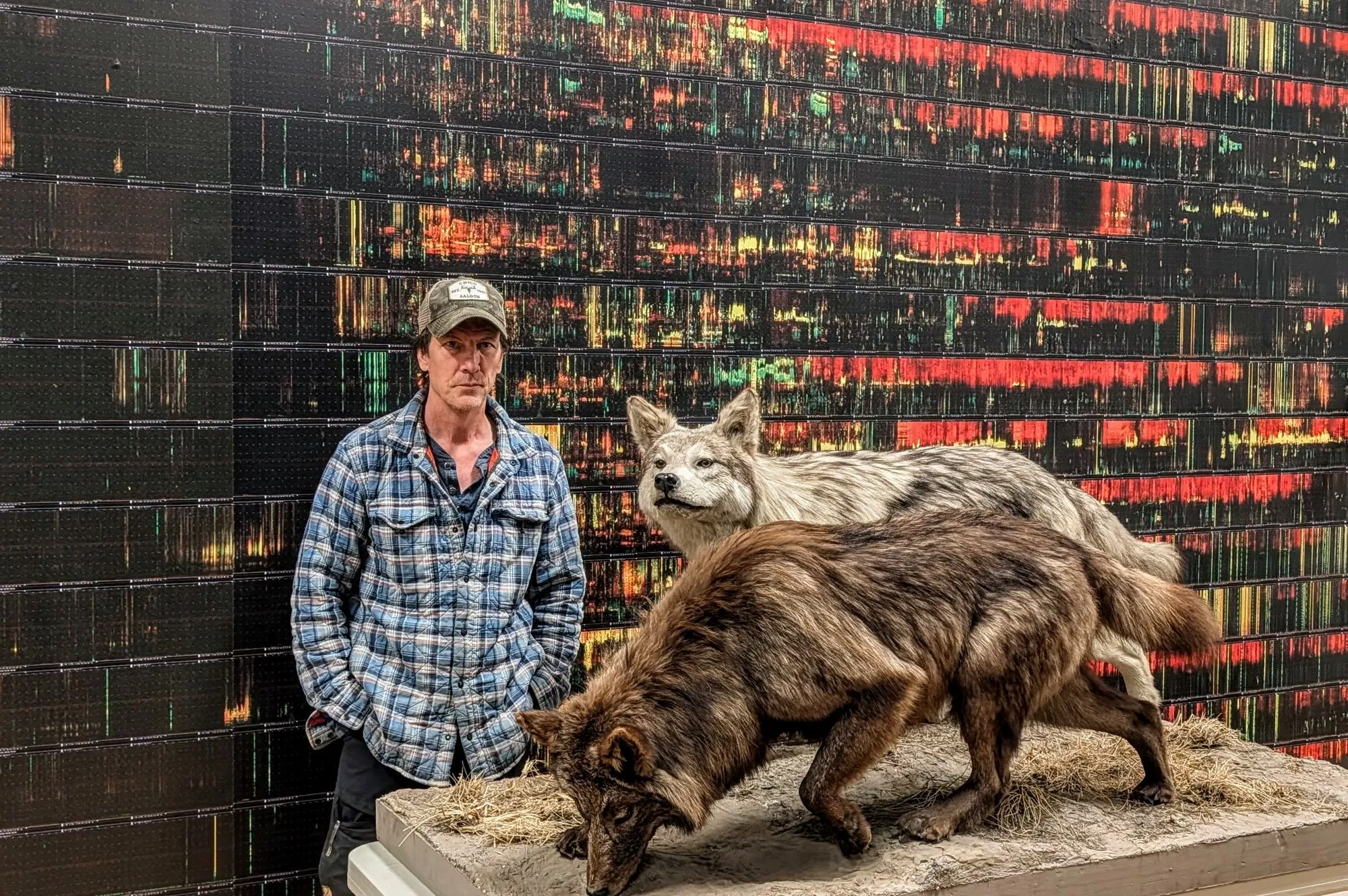
1926.
Under the government's predator eradication program, a park ranger took two wolves that may have been the last killed in Yellowstone. The park put them on display in a museum case in Mammoth.
Then nothing.
No howl in Yellowstone. The two wolves stood in their case while the park went quiet around them.
This is what seventy years of silence sounds like when it ends.
Wolves came back to Yellowstone in 1995. Those two had been standing in their case for sixty-nine years.
It's about the future of wildness itself, for hunters and non-hunters alike.
Do you want any wild left?
The wild is a forearm. The dogs are the other one. Both are in your hands.
Keep the arm · support the researchCredit where it's due
- Yellowstone National Park's Wolf Project, led by Dan Stahler, and the National Park Service, whose recordings and photographs this page draws on.
- Biomass figures: Greenspoon, Krieger, Sender, Rosenberg, Bar-On, Moran, Antman, Meiri, Roll, Noor and Milo, "The global biomass of wild mammals," PNAS 2023.
- Wild carnivore share: Hannah Ritchie and Fiona Spooner, Our World in Data, from the same study.
- Brain energy: Raichle and Gusnard, "Appraising the brain's energy budget," PNAS 2002.
- Wolf 907 photograph: Evan Stout.
- Jeff and Ozzie photograph: Ami Vitale.
- 1995 recording: Bob Landis. Spectrogram video: Bob Landis and Jeffrey T Reed.
- The 1926 wolves: Yellowstone museum collection, YELL 6322 and YELL 10896.
The numbers behind the dots
| Group | Million tonnes | Share | On the body |
|---|---|---|---|
| People | 390 | 37% | Head, chest, upper arms |
| Livestock | 630 | 59% | Belly, hips, legs |
| Dogs | ≈20 | ≈2% | Left forearm and hand |
| Wild land mammals | 20 | 1.9% | Right forearm and hand |
| Of which wild carnivores | ≈0.6 | ≈0.06% | About a little finger |
Live weight, land mammals only. With whales and seals counted, wild mammals come to about six percent of the total.